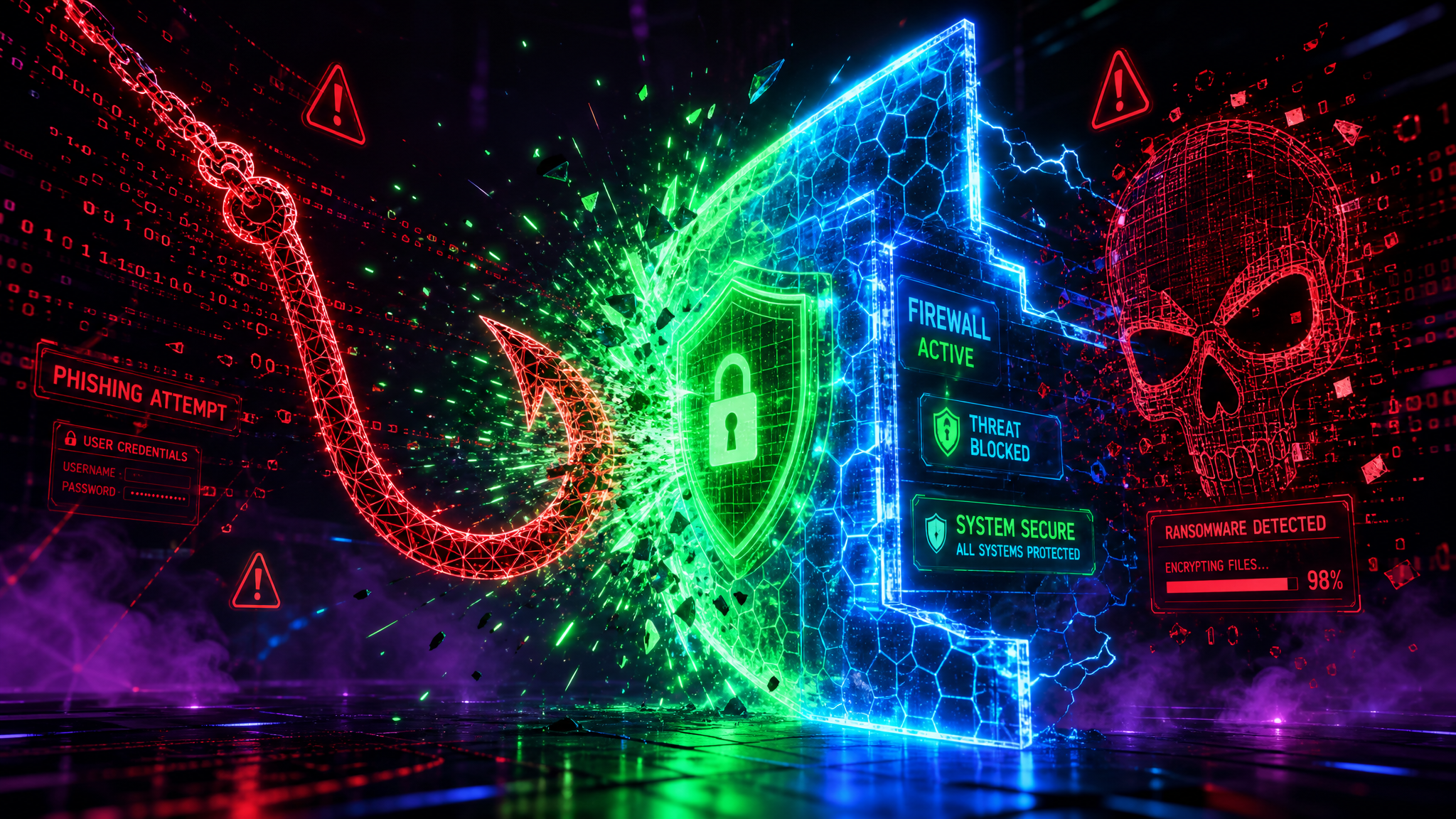
Ransomware — Data Encryption and Extortion at Scale
Ransomware remains one of the most devastating categories of cyberattack facing businesses in 2025. Malicious software infiltrates a company's infrastructure, systematically encrypts files across servers and workstations, and criminals then demand a ransom — typically paid in cryptocurrency — in exchange for the decryption key. What makes ransomware particularly dangerous is its ability to bring entire organizations to a complete standstill within hours. Across Europe, 2024–2025 has seen a record number of ransomware incidents targeting small and medium-sized enterprises (SMEs), many of which lack the internal security resources to respond effectively.
How a Ransomware Attack Unfolds
Understanding the attack lifecycle is the first step toward building an effective defense. A typical ransomware intrusion follows a predictable sequence:
- Initial Infection — The attacker gains a foothold most commonly through a phishing email with a malicious attachment, a drive-by download, or by exploiting an unpatched vulnerability in internet-facing software (e.g., VPN gateways, RDP services, or web applications).
- Lateral Movement — Once inside the network, the malware or the attacker behind it moves laterally, escalating privileges and mapping internal systems to maximize the impact of the eventual encryption phase.
- Data Exfiltration — Modern ransomware groups frequently steal sensitive data before encrypting it, enabling a double-extortion strategy: pay the ransom or your data gets published.
- Encryption — Files across servers, shared drives, and endpoints are encrypted using strong asymmetric cryptography, rendering them inaccessible without the attacker's private key.
- Ransom Demand — A ransom note is displayed, often with a countdown timer to increase psychological pressure and urgency.
How to Protect Your Business from Ransomware
- Implement the 3-2-1-1-0 Backup Strategy — Maintain at least 3 copies of your data, on 2 different media types, with 1 copy stored off-site, 1 copy air-gapped (completely disconnected from the network), and 0 errors verified through regular restore testing. Backups that have never been tested are not reliable backups.
- Network Segmentation — Divide your internal network into isolated segments so that a compromise in one area cannot freely propagate to critical systems. Micro-segmentation is especially important in environments running microservices or containerized workloads.
- Patch Management — Apply security patches immediately upon release, prioritizing internet-facing systems, VPNs, and web application frameworks. The majority of successful ransomware intrusions exploit known, patchable vulnerabilities.
- Endpoint Detection and Response (EDR) — Deploy EDR solutions capable of detecting behavioral anomalies associated with ransomware execution, such as mass file renaming or shadow copy deletion.
- Penetration Testing — Regular penetration tests identify the attack vectors that ransomware operators would exploit before they do. Web application pentests, infrastructure assessments, and internal network simulations all contribute to closing critical gaps.
- Principle of Least Privilege — Restrict user and service account permissions to the minimum required. Ransomware can only encrypt what the compromised account has access to.
Phishing — Social Engineering Targeting Your People
Phishing is consistently the most common initial attack vector in cybersecurity incidents worldwide. Attackers impersonate trusted entities — banks, government agencies, software vendors, or even internal colleagues — and craft convincing messages designed to steal login credentials, deliver malware, or manipulate employees into taking harmful actions. In 2025, phishing attacks have grown significantly more sophisticated, largely due to the widespread adoption of AI-assisted content generation by threat actors.
Types of Phishing Attacks to Know in 2025
- Email Phishing — Mass campaigns impersonating well-known brands, financial institutions, or cloud service providers (Microsoft 365, Google Workspace, DocuSign).
- Spear Phishing — Highly targeted attacks against specific individuals or organizations, using personalized information gathered from LinkedIn, company websites, or previous data breaches.
- Vishing (Voice Phishing) — Attackers call employees directly, impersonating IT support, bank representatives, or executives to extract sensitive information or credentials.
- Smishing (SMS Phishing) — Fraudulent text messages containing malicious links, often disguised as delivery notifications or banking alerts.
- Deepfake Phishing — An emerging and rapidly growing threat in 2025: attackers use AI-generated audio or video to impersonate executives (CEO fraud), tricking employees into authorizing wire transfers or disclosing access credentials.
How to Recognize and Respond to Phishing Attempts
- Verify the sender's actual email address, not just the display name — attackers routinely spoof display names while using unrelated domains.
- Hover over links before clicking to inspect the actual destination URL. Look for subtle domain misspellings (e.g., micros0ft.com or paypa1.com).
- Be suspicious of urgency — messages claiming your account will be suspended, a payment is overdue, or immediate action is required are classic social engineering pressure tactics.
- Use a secondary verification channel — if an email requests a sensitive action, call the sender directly using a known, trusted phone number to confirm.
- Deploy DMARC, DKIM, and SPF on your email domain to reduce the risk of your own domain being spoofed in phishing campaigns targeting your clients or partners.
- Conduct regular phishing simulation exercises to measure and improve employee awareness over time.
What Does a Cyberattack Actually Cost?
The financial impact of a ransomware incident extends far beyond any ransom payment. When you factor in operational downtime, data recovery costs, regulatory fines (particularly under GDPR), reputational damage, and the cost of rebuilding compromised infrastructure, the average total cost of a ransomware incident for a mid-sized European business in 2025 exceeds €100,000 — and frequently reaches several times that figure. For many SMEs, a single serious incident can be existential.
By contrast, a professional security audit — including web application penetration testing, API security assessment, infrastructure review, and phishing resilience evaluation — represents a fraction of that cost and can identify and remediate the vulnerabilities that attackers would otherwise exploit.
At MonMyIP, we specialize in web application pentesting, REST and GraphQL API security, HTTPS/TLS configuration audits, and comprehensive web infrastructure assessments. Our security experts help businesses identify their real attack surface before threat actors do — giving you actionable findings and clear remediation guidance, not just a generic report.
Contact MonMyIP today to schedule a ransomware and phishing resilience audit for your business →