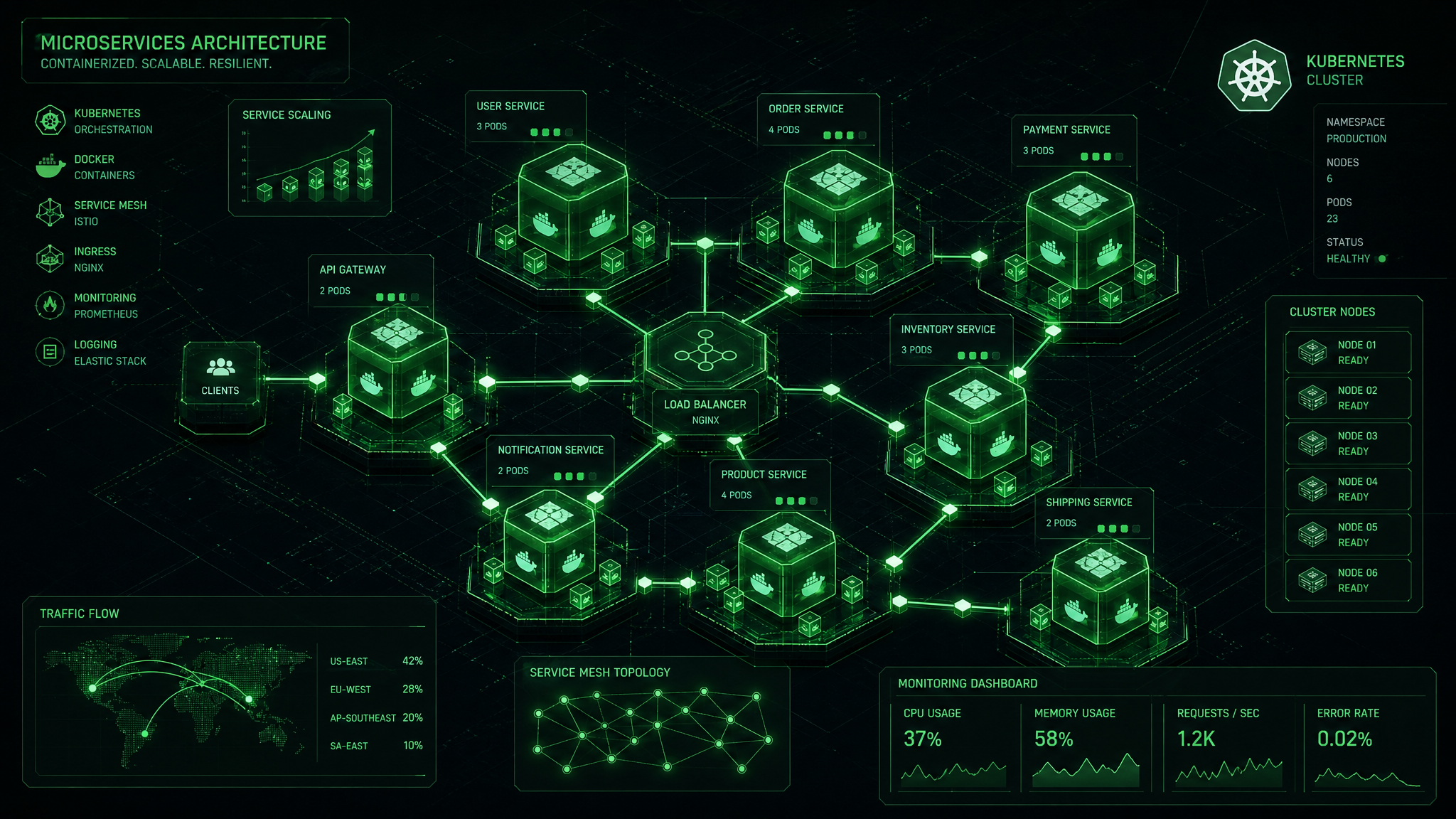
Microservices Security Challenges
Microservices improve scalability and deployment speed, but they also expand the attack surface. Instead of securing one monolith, architects must protect dozens or hundreds of APIs, containers, identities, and network paths. Every service becomes a potential entry point, and every integration must be treated as untrusted by default.
- More east-west traffic inside the cluster increases interception and spoofing risk.
- Distributed ownership makes policy drift and inconsistent controls more likely.
- Small security mistakes can spread quickly through shared libraries and automated pipelines.
Secure Service-to-Service Communication
mTLS should be the default for internal traffic. Mutual certificate-based authentication ensures that both sides prove identity before exchanging data, reducing the risk of impersonation and man-in-the-middle attacks.
Service Mesh platforms such as Istio or Linkerd can enforce encryption, certificate rotation, retries, and traffic policy centrally. This is especially useful when teams need consistent security controls across many services.
- Use short-lived certificates and automate rotation.
- Validate service identity, not just network location.
- Define explicit allowlists for service-to-service calls.
- Apply rate limiting and request timeouts to reduce abuse and cascading failures.
Identity, Authentication, and Authorization
Do not rely on the perimeter alone. Every API should verify the caller and every sensitive action should be authorized at the application level. External users, internal services, and automation systems should have distinct identities and separate privileges.
OAuth 2.0 and OpenID Connect are common choices for user-facing authentication, while service accounts and signed tokens are better for machine-to-machine access. Tokens should be short-lived, audience-bound, and validated against the expected issuer.
- Enforce least privilege with role-based or attribute-based access control.
- Separate admin APIs from public APIs.
- Reject requests with missing or malformed claims.
- Log authorization failures for detection and forensics.
Secrets Management
Never store passwords, API keys, certificates, or private keys in source code, container images, or environment files committed to Git. Use centralized secret stores such as HashiCorp Vault, AWS Secrets Manager, or Kubernetes Secrets with encryption and access policies.
Secrets should be injected at runtime, rotated regularly, and scoped to the smallest possible workload. If a secret is exposed, its lifetime should be short enough to limit damage.
- Rotate credentials automatically and revoke unused secrets.
- Avoid long-lived static keys.
- Restrict secret access to specific namespaces and workloads.
- Scan repositories and CI logs for accidental leaks.
Container and Supply Chain Security
Every container image is part of the attack surface. Build from minimal base images, run as a non-root user, and remove unnecessary tools and packages. Immutable containers should be replaced, not patched in place.
Scan images for known vulnerabilities before deployment and maintain an SBOM to track third-party components. Signed images and admission policies help prevent untrusted artifacts from entering production.
- Use read-only filesystems where possible.
- Drop Linux capabilities not required by the workload.
- Pin dependencies and verify checksums.
- Enforce build provenance in CI/CD pipelines.
Network Segmentation and Runtime Protection
Microservices should not communicate freely by default. Use Kubernetes NetworkPolicies, namespace isolation, and cloud security groups to limit lateral movement. A compromised pod should not be able to reach every database or internal endpoint.
At runtime, monitor anomalous behavior such as unexpected outbound traffic, privilege escalation attempts, or unusual process execution. Defense-in-depth matters because prevention controls will not stop every attack.
Logging, Monitoring, and Incident Response
Security visibility is essential in distributed systems. Correlate logs, metrics, and traces with consistent request IDs so teams can reconstruct incidents quickly. Alert on authentication anomalies, policy violations, and sudden spikes in error rates.
- Centralize logs and protect them from tampering.
- Redact sensitive data before storage.
- Create runbooks for service compromise and credential rotation.
- Test incident response with tabletop exercises.
MonMyIP: Keep Exposure Under Control
Architects should continuously verify what is exposed to the internet and how public endpoints change over time. MonMyIP helps teams monitor their public IP and maintain visibility into infrastructure changes that can reveal misconfigurations, VPN issues, or unexpected exposure.
Use that visibility as part of your security baseline: know what is public, reduce what is unnecessary, and verify that your microservices architecture remains tightly controlled. In modern environments, good security starts with knowing what can be reached from the outside.