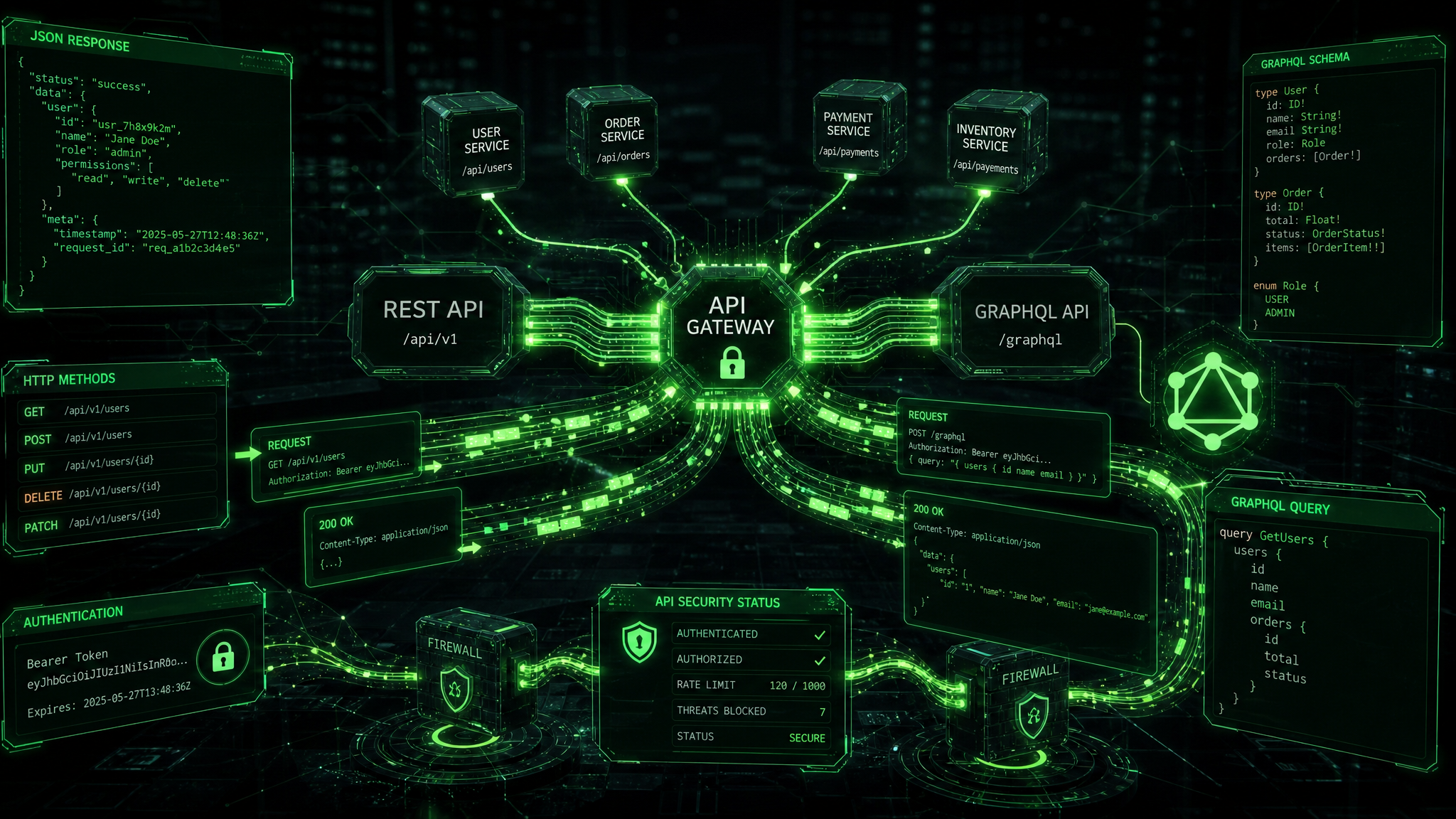
Why is API Security Critical?
APIs are the backbone of modern web applications. Most sensitive flows pass through them, including user profiles, authentication, payments, and internal service communication. If an API is exposed without proper controls, attackers do not need to break the frontend — they can interact directly with the business logic behind it.
REST and GraphQL APIs are especially attractive targets because they often expose rich data and perform high-value actions. A single weak endpoint can lead to data leakage, account takeover, privilege escalation, or business disruption.
REST vs GraphQL: What Changes in Security Testing?
REST APIs usually rely on multiple endpoints and HTTP methods, which makes access control, parameter validation, and rate limiting the main focus. GraphQL is different: a single endpoint can expose a very large attack surface through queries, mutations, aliases, fragments, and nested objects.
REST testing focuses on endpoint-by-endpoint behavior, object-level authorization, input handling, and HTTP response consistency.
GraphQL testing focuses on query depth, complexity, introspection exposure, resolver authorization, schema abuse, and whether the API allows excessive data access through nested queries.
Common API Threats
Broken Object Level Authorization (BOLA) — attackers can access other users’ data by manipulating object identifiers in requests. This is one of the most common and dangerous API issues.
Broken Authentication — weak JWT handling, missing token rotation, poor signature validation, and unsafe session handling can allow impersonation or token reuse.
Excessive Data Exposure — the API returns more data than the client actually needs, making sensitive fields easier to steal.
Mass Assignment — attackers modify object fields they should not control, such as roles, account status, or payment-related parameters.
Injection — unsanitized input can reach SQL, NoSQL, command execution, or GraphQL resolver logic.
How We Test APIs at MonMyIP
At MonMyIP, we follow the OWASP API Security Top 10 methodology and combine manual analysis with security tooling. Our goal is to verify not only whether the API is reachable, but whether it behaves securely under attacker-controlled input.
Authentication and Session Security
- Check JWT structure, signature algorithms, expiration, issuer, and audience validation.
- Verify refresh token handling, rotation, revocation, and reuse detection.
- Test for weak credential policies, MFA bypasses, and session fixation risks.
Authorization and Access Control
- Attempt horizontal and vertical privilege escalation.
- Change identifiers, user IDs, order IDs, and nested object references.
- Test role-based restrictions across endpoints, resolvers, and admin functions.
Input Validation and Business Logic
- Send malformed, oversized, unexpected, and boundary-value payloads.
- Test for mass assignment by submitting hidden or unauthorized fields.
- Review whether validation is enforced server-side, not only in the client.
Rate Limiting, Logging, and Error Handling
- Check whether brute-force and enumeration are blocked by throttling.
- Inspect logs for sensitive data exposure and missing security events.
- Verify that error messages do not reveal stack traces, schema details, or internal logic.
GraphQL-Specific Checks
- Test introspection exposure in production environments.
- Measure query depth and complexity to prevent resource exhaustion.
- Inspect resolver-level authorization for nested objects and relations.
Practical Recommendations
Secure APIs start with secure design. Use least privilege for every endpoint, enforce authorization on the server side, and validate every input against an allowlist. For GraphQL, limit query depth, disable unnecessary introspection in production, and apply complexity controls.
Protect authentication with strong token lifecycle management, short-lived access tokens, secure key rotation, and consistent signature verification. Monitor anomalies, log security-relevant events, and make sure rate limiting applies to both login and data-heavy endpoints.
Need an API Security Review?
If your organization exposes REST or GraphQL APIs, MonMyIP can help you identify weaknesses before attackers do. We perform focused security testing, explain the real business impact, and provide clear remediation guidance for developers and DevOps teams.
Contact MonMyIP to schedule an API security assessment and strengthen your defenses across authentication, authorization, and data protection.